Twenty-five years ago, you wouldn’t have found many power companies that didn’t rely on Supervisory Control and Data Acquisition (SCADA) as part of their critical infrastructure. Put simply, utilities could not operate their business without it. Operators sat in control centers, issuing commands to substations and switchgear, managing transmission lines and grid operations in a system designed around the predictable flow of electricity from large, centralized generation assets.
Today, something similar is happening at the grid edge that is reshaping what “essential infrastructure” means. Distributed Energy Resource Management Systems (DERMS), which are used to manage distributed energy resources (DERs) like batteries, solar photovoltaic, electric vehicle (EV) chargers and demand response programs at scale, are approaching that same threshold SCADA crossed decades ago. Once viewed as an optional software system, DERMS platforms are approaching critical infrastructure status within utilities nationwide—and we are hitting the inflection point in 2026.
Why DERMS means operational necessity today (and where we see threshold moment happening)
The simple truth is that utility executives have crossed the point of asking, “ Do we need DERMS?” and are now asking, “How can we operate without DERMS?” The reasons can be summarized as shifts across three vectors:
- Vector #1: Supply is being redefined by accelerated decarbonization timelines
- Vector #2: Reliability expectations are changing faster than ever
- Vector #3: Customer flexibility is now part of the grid management equation
These three vectors are influencing how utilities think about DERMS technology today and where we expect the tipping point to occur across the industry.
Vector #1: Supply is being redefined by accelerated decarbonization timelines
With US electricity needs estimated to grow by 200GW by 2030, utilities face an operational reality where traditional generation can't cover evening peaks without aggregating distributed resources.
Factor in that IIR Energy's power plant tracking reports that around 78 gigawatts (GW) from 167 coal units at 81 plants are planned for retirement over the next two decades. As fleets of dispatchable generation powered by fossil fuels shut down, the strain will fall disproportionately on systems that aren’t yet ready to manage high penetrations of DERs.
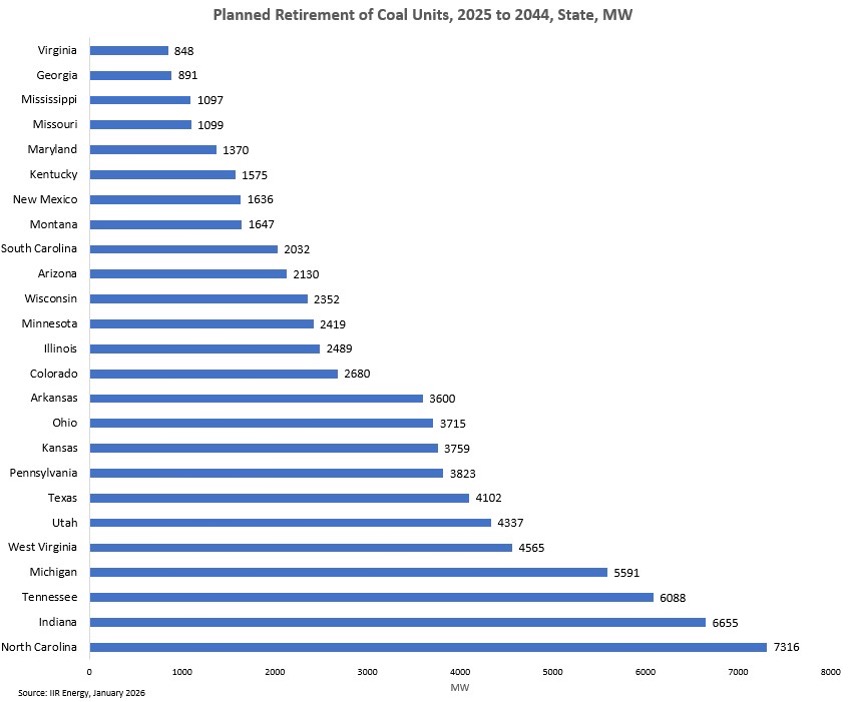
Planned Retirement of Coal Units, 2025 to 2044, State, MW
Source: IIR Energy, January 2026
DER resources aren’t just adding new capacity—they’re fundamentally different than traditional generation assets. Unlike baseload coal plants that run smoothly between scheduled outages, DER facilities can frequently change how much electricity they generate or consume from one moment to the next. A utility-scale solar farm delivers power only during the day; stored battery packs can be dispatched but have limited energy capacity; demand response programs leverage customer flexibility to shift load, but aren’t always easily predicted. Orchestrating this level of flexibility at scale—aligning distributed resources with grid needs in real time—is only possible with DERMS.
To be clear, utilities have added DERs to the grid for decades and have long used DERMS pilots to tap into flexibility from small sets of distributed resources as part of grid management programs. Systems without DERMS technology have found ways to continue integrating DERs, but they’re now managing millions of highly dynamic, bidirectional endpoints rather than the thousands of largely one-way assets legacy systems were built to manage. And they’re doing it while navigating aggressive decarbonization mandates and heightened reliability expectations that were virtually unheard of just a few years ago. The challenge today is not only one of scale, but of variability and complexity.
Vector #2: Reliability expectations are changing faster than ever
Maintaining reliability means managing the transition from legacy generation assets to new flexible resources like DERs. Extreme weather events have also exposed weaknesses in traditional reliability planning tools, indicating that it’s not enough for utilities to respond to reliability issues. They need to anticipate them before they happen. The utility industry’s obsession with reliability scores isn’t going to let up either. From JD Power customer satisfaction scores to performance incentives designed by regulators, utilities are being held accountable for reliability like never before.
DERMS platforms help manage both challenges. Integrating advanced metering infrastructure (AMI) and DERMS technology lets utilities tap into flexibility from millions of customer endpoints across DERs, customer-owned batteries and load. Utilities are already using this capability to create real-time visibility into distribution feeder voltages and enable remote load management for the first time, providing a new tool for outage prevention and response.
DERMS platforms that integrate utility-scale solar, battery storage resources and legacy grid infrastructure likewise give operators visibility into how distributed assets and centralized plants will operate fleet-wide at any point in the future—essential information when you’re planning how to keep the lights on for tens of millions of customers.
Vector #3: Customer flexibility is now part of the grid management equation
DERMS solutions also align directly with changing customer experience expectations. Utilities need access to distributed customer-side flexibility to manage reliability at scale, but they need to do it without taking away what matters most to customers: comfort, convenience and choice.
The bottom line for customers is simple: stay cool in summer, stay warm in winter and have a cold beer waiting for you when you get home. Demand response programs that disrupt customer comfort will create irritated customer lines…literally. DERMS technology that can coordinate both grid-side assets like substations, batteries and solar plants with customer-side devices solves that problem. These systems give utilities visibility into how much flexibility is available from customer-side assets at any given moment—not just how much load can be shed, but also how much demand can be added if that creates more value for grid operators.
Flashback to SCADA: Technology threshold moments matter
Ask most utility executives what SCADA is, and you’ll get a quick answer: SCADA refers to the combination of hardware and software that lets utilities monitor and control substations, switchgear and grid assets remotely—a capability that has been part of how every electric utility does business for decades. Emerging in the 1970s and 80s, SCADA was a “big tech bet” in many ways—costly to install and maintain, disruptive to organizational processes and often pitched to capital committees by enthusiasts rather than engineers. Gradually, as grids got more complex and chaotic, SCADA earned its keep operationally and began moving out of the innovation budget and into the infrastructure budget.
DERMS is tracing a familiar trajectory. Certain utilities have been validating this technology for years—Germans interfacing with prosumers, Australians triaging too much distributed solar on their systems and coastal utilities in the U.S. dealing with grid hosting capacity issues. But we’ve learned from their experience what fundamental qualities second-generation DERMS platforms need to be considered operationally reliable: interoperability with other systems, scalability to any number of endpoints and coordination of grid-side and customer-side assets within integrated operational workflows—and now that understanding is spreading to capital committees.
DERMS coming out of 2026 will be different because utilities are no longer treating these systems as experimental. Budgets are being drafted to move DERMS solutions out of pilot programs and innovation initiatives into 3-, 5- and 10-year capital plans alongside grid modernization, AMI deployments and other core infrastructure investments.
With that shift comes a higher bar. Utilities now expect DERMS to be utility-grade and fully baked, with end-to-end testing and validation that demonstrate high confidence at scale. The questions being asked have changed from “can it work?” to “can it perform reliably in real-world operating conditions?” and, increasingly, “what does it cost us NOT to have it?” That inflection point—where a system must prove itself as bullet-proof and operationally trusted as SCADA—is the hallmark of any piece of technology that’s about to go infrastructure-sized.
The AMI connection: An infrastructure asset often overlooked
A piece of the DERMS discussion frequently undersold when discussing market opportunities is AMI. Because tens of millions of distributed intelligent meters are already in the field across the U.S., utilities have grid-edge communications and control layer that is vastly more capable than the legacy metering solution it replaced. Modern smart meters are no longer merely measurement devices—they are networked computers able to run multiple applications that support grid monitoring, outage detection, load control and real-time visibility, and they’re already changing how utilities manage reliability.
DERMS platforms designed to leverage AMI technology gain a powerful operational edge. Treating AMI as siloed from grid management and customer participation leaves value on the table. An “edge DERMS” architecture, which is purpose-built to manage customer-side assets via the AMI layer, allows demand flexibility programs to integrate with grid operational systems to produce two-way value: improved customer programs with visibility into grid conditions in real time and grid operations made more efficient by previously hidden flexible load.
Today’s smart meters can also provide real-time feedback and alerts that highlight emerging grid-asset overload conditions. When paired with DER visibility, availability and control, utilities gain the ability to dispatch local flexibility to stabilize conditions and reduce the risk of subsequent outages. As these capabilities are unlocked at scale, endpoints are shifting from passive meters into active grid assets.
We are starting to see broader industry recognition of AMI’s importance to DERMS functionality—and how utilities should be thinking about these technology investments.
Adoption barrier: Organizational readiness
Maturity of enabling technologies is necessary but not sufficient for DERMS to reach critical mass. An equally important condition is organizational readiness—and many utilities are still working through internal hurdles that slow adoption.
The challenge is often structural. The entities that run grid operations and the entities that run customer programs have historically been separated within utility organizations, with little coordination between the two groups. Grid operations are concerned with reliability of the transmission and distribution grid, while demand response and energy efficiency program managers are concerned with customer outreach and load shaping. They use separate systems that report into separate branches of the organizational hierarchy and often have limited awareness of each other’s needs.
Some utilities are beginning to move toward a more integrated operating model. Sacramento Municipal Utility District (SMUD), for example, has publicly described efforts to align grid edge visibility, flexible customer programs and operational planning as part of its broader reliability and decarbonization strategy. Utilities undergoing similar organizational transitions are finding that closer coordination between grid operations, AMI and customer programs can reduce friction and accelerate deployment. As a result, DERMS initiatives that once required lengthy pilot phases are increasingly being stood up more quickly as utilities align people, processes and systems around shared operational goals.
Closing thought: There’s no going back from a DERMS future
SCADA didn’t become critical infrastructure overnight. It reached a point of no return as a series of small decisions and growing operational truths that made going back impossible. DERMS is crossing that threshold right now in 2026. In fact, utilities have added DER to the grid for decades, and early adopters have been proving DERMS concepts for years.
Global deployments illustrate how DERMS is moving from pilot technology to core infrastructure, particularly as utilities integrate customer-side flexibility directly into grid operations.
In North America, Xcel Energy (Colorado) provides a clear example of this shift. Through its Renewable Battery Connect (RBC) program, Xcel has used DERMS capabilities to onboard and coordinate thousands of customer-owned batteries, enabling the aggregation of more than 15 MW of flexible capacity in under six months. The program lays the foundation for Colorado’s first battery-owned virtual power plant while demonstrating how DERMS can bridge customer programs and real-time grid needs. Xcel has outlined plans to expand this model to include solar, electric vehicles and thermostats, significantly increasing the scale and operational importance of DERMS across its system. Hawaii Electric has also been an early and aggressive DERMS adopter, given Hawaii's exceptionally high rooftop solar penetration, using the technology to manage reverse power flows and voltage issues on distribution feeders.
In Europe, distribution system operators in Germany, the UK and the Netherlands have deployed DERMS as part of broader smart grid initiatives, where high renewable penetration has made real-time DER coordination a grid stability necessity rather than an option. National Grid in the UK, for instance, has been actively managing behind-the-meter flexibility resources through DERMS-enabled demand response programs.
Utilities across the globe are using DERMS to enable virtual power plant participation at scale. In Western Australia, Synergy is participating in Project Jupiter, a multi-utility initiative that uses DERMS-based coordination to register and manage rooftop solar and customer batteries, enabling households and businesses to participate in virtual power plants under emerging interoperability standards.
The millions of distributed energy resources already connected to the grid (and millions more that will be added in the next 5 years) will not be whipped into reliability by spreadsheets and phone calls. They need real-time, operational technology that can see, coordinate and optimize across assets at the edge. These platforms operate at utility-scale today. The capital committees that must prioritize them are just starting to realize why.

Nick Tumilowicz is a thought leader, strategist and a recognized expert in DER management. In his current role as Itron's director of product, Tumilowicz leads the Distributed Energy Management business unit, accountable for global product development of Demand Response, DER and Forecasting solutions that enable access to flexible customer energy resources. Tumilowicz holds a variety of positions on advisory councils, including Department of Energy (NREL, Building Technologies Office, Solar Energy Technologies Office), Department of Defense (Naval Research Laboratory), General Services Administration, California Energy Commission, Grid Forward Leadership Committee, Incubate Energy Labs, Saudi Gulf Cooperation Council Interconnecting Authority and regularly informs Public Utility/Service Commissions across the U.S.