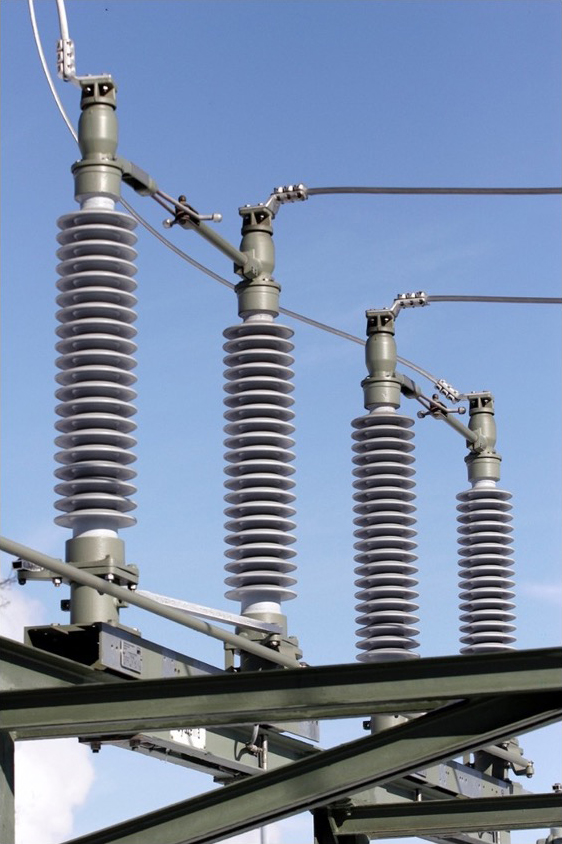
Silicone composite insulators support high-voltage equipment in an outdoor substation, where hydrophobic, weather-resistant housings contribute to long-term insulation performance. (Source: WACKER)
Transmission and distribution assets must perform for decades while facing moisture, contamination, ultraviolet radiation, temperature cycling and mechanical stress. North American load forecasts add urgency to those decisions. NERC’s 2025 Long-Term Reliability Assessment identifies data centers and other large commercial and industrial loads as the leading source of projected demand growth over the next decade. Equipment manufacturers and utilities often evaluate these demands through electrical ratings, mechanical loads and service conditions. Material chemistry sits underneath each requirement because the formulation and processing of an insulating elastomer determine how the finished component behaves over time.
Silicone rubber has become an established material for insulators, surge arresters, bushings, cable joints, terminations, connectors and coatings for ceramic and glass insulation. Its value comes from a combination of surface hydrophobicity, dielectric performance, weather resistance, flexibility and processability. The label “silicone” covers a broad family of materials. Polymer structure, reinforcing fillers, functional additives, cure chemistry and manufacturing conditions work together to create the performance profile of a specific material system.
For asset management teams, this chemistry has practical consequences. Material decisions made during component development influence resistance to contamination, the consistency of outdoor performance, installation and handling characteristics, maintenance requirements and service life. This article examines how silicone formulation, processing and application design connect materials science with the long-term performance of T&D components.
A performance profile begins with formulation
Silicone elastomers used in electrical applications generally rely on a polydimethylsiloxane polymer backbone. The silicon-oxygen chain gives the material high molecular flexibility, low surface energy and stability across a broad temperature range. These inherent characteristics provide the foundation for hydrophobicity, elasticity and weather resistance, although the polymer represents only one part of the final compound.
Formulators use reinforcing silica to build mechanical strength and control rheology. Mineral fillers can improve resistance to tracking and erosion under electrical stress. Crosslinking agents establish the cured network, while catalysts, inhibitors and other additives control the cure profile and production window. Pigments and functional additives may support identification, flame performance, electrical conductivity or other application requirements. Each adjustment creates trade-offs among processing behavior, mechanical properties, electrical performance and long-term surface behavior.
Cure chemistry adds another layer of control. Heat-cured solid silicone rubber, liquid silicone rubber, extra-low-viscosity systems and room-temperature-curing materials serve different manufacturing methods and component geometries. A compound developed for injection molding an insulator housing needs a different viscosity and cure profile than a spray-applied coating or a low-pressure material used around a hollow composite core. Cable accessories may require permanently elastic insulating, conductive and semiconductive materials that manufacturers can mold with precise interfaces.
These differences explain why a material specification should describe the required performance and processing route with greater precision than a generic callout for silicone rubber. A material supplier can help an equipment manufacturer connect service conditions with compound architecture, cure behavior and manufacturing equipment. That collaboration reduces the risk of selecting a material that performs well in a laboratory data sheet yet creates instability during mixing, metering, molding, extrusion or curing.
Hydrophobicity under contaminated conditions
Outdoor insulation accumulates salt, dust, industrial residue and other contaminants according to the local environment. When moisture wets a contaminated hydrophilic surface, dissolved ions can increase surface conductivity. Silicone rubber responds differently because its low surface energy encourages water to form droplets instead of spreading into a continuous film. This behavior can interrupt conductive paths across the surface and support resistance to leakage current and flashover under polluted conditions.
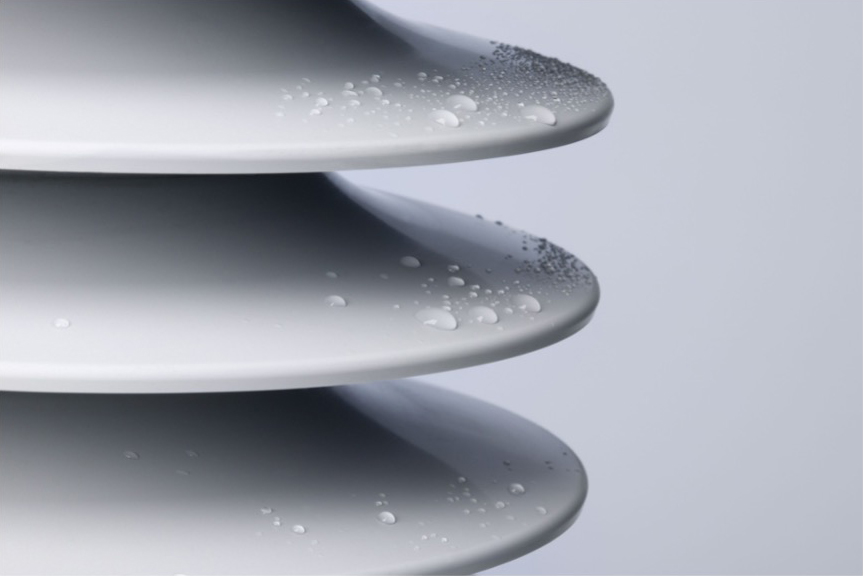
Caption: Water beads on a hydrophobic silicone insulator surface, helping limit the formation of continuous conductive moisture films. (Source: WACKER)
Silicone also exhibits hydrophobicity transfer. Low-molecular-weight siloxane species can migrate from the bulk elastomer toward the surface and into an adjacent contamination layer. As that transfer progresses, deposited grime can acquire water-repellent characteristics. This dynamic recovery helps explain why silicone insulation can retain useful surface behavior after contamination or temporary environmental stress.
Formulation controls the rate and extent of that response. The polymer system, filler package, crosslink density and concentration of mobile siloxane species influence hydrophobicity and its recovery after stress. Severe contamination, sustained electrical activity and aging can alter surface behavior, so a credible performance assessment considers both initial hydrophobicity and the material’s ability to recover it over time.
This chemistry applies across several T&D component types. Silicone housings on rod and hollow-core insulators use hydrophobic surfaces to support outdoor insulation performance. The same formulation principles apply to silicone housings used for surge arresters and bushings, where hydrophobicity, weather resistance, dielectric performance and process consistency contribute to long-term environmental protection. In every case, the material operates within a complete component whose geometry, interfaces and manufacturing quality also influence performance.
Weather resistance and permanent elasticity
T&D components encounter long periods of sunlight, ozone, heat, cold and repeated temperature changes. Silicone elastomers can maintain flexibility across a broad temperature range and resist degradation from ultraviolet radiation and ozone. These properties come from the chemistry of the siloxane backbone and from a formulation designed for the expected exposure. The resulting material can continue to provide electrical insulation and environmental protection without becoming brittle under ordinary outdoor aging conditions.
Flexibility also supports mechanical durability. Silicone housings can tolerate impact and handling without the brittle fracture behavior associated with ceramic materials. Composite insulator designs can reduce finished-component weight substantially compared with porcelain designs, depending on the construction and duty. Lower weight and a resilient housing can support transportation and installation, especially where access or lifting conditions create constraints. The component manufacturer still determines the final design, mechanical rating and installation requirements.
Permanent elasticity plays a different role in cable accessories. Joints and terminations must maintain intimate contact with cable insulation as load cycles produce thermal expansion and contraction. A properly formulated silicone elastomer can retain radial pressure over a wide temperature range while preserving dielectric performance. Manufacturers can also use conductive and semiconductive silicone grades within molded accessory designs to support electrical field control at material interfaces.
These applications show why long-term performance requires more than resistance to one environmental factor. An elastomer must preserve its electrical, mechanical and surface properties as those stresses interact. Formulation development therefore balances dielectric strength, tracking and erosion resistance, tear strength, elongation, compression behavior, thermal stability and weathering performance for the intended component and processing method.
Processing is part of material performance
A silicone compound reaches the grid only after an equipment manufacturer converts it into a finished component. Processing influences dispersion, cure, adhesion, dimensions and surface quality, which means that production conditions become part of the material-performance equation. The same base chemistry can produce different results when mixing, metering, temperature control or cure conditions vary.
High-consistency silicone rubber supports processes such as extrusion and injection or compression molding. Liquid silicone rubber can provide automated mixing and metering, rapid cure and detailed molding for complex geometries. Extra-low-viscosity systems can fill large or intricate molds at low pressure, an advantage for hollow-core insulator production where manufacturers need controlled flow around a composite structure. Room-temperature-curing materials support coatings and selected cable-accessory manufacturing routes when ambient cure better fits the application.
Rheology influences whether a material fills a mold without trapping air, maintains a coating thickness on vertical surfaces or extrudes with consistent dimensions. Cure kinetics affect cycle time, adhesion development and the risk of undercured or overcured regions. Filler dispersion influences mechanical and electrical consistency, while surface preparation can determine the adhesion of a coating to ceramic, glass, metal or polymeric substrates. These variables fall directly within the shared work of material chemists, process engineers and component manufacturers.
A chemical manufacturer contributes by developing compounds for defined processing windows, characterizing material behavior and helping customers translate laboratory properties into stable production. That support may include rheological analysis, cure studies, adhesion evaluation, processing trials and troubleshooting around mixing or molding conditions. The equipment manufacturer retains responsibility for component design and qualification, while the material supplier provides expertise in the chemistry and process behavior of the elastomer.
This division of expertise strengthens reliability because it keeps each technical question with the party best equipped to answer it. Utilities and asset owners can benefit from the result without expecting a material supplier to design the full component or prescribe operating practices. The most dependable outcome comes from a chain of validated decisions that begins with formulation and continues through manufacturing, qualification and field use.
Coatings as a materials-based retrofit option
Existing ceramic and glass insulators can present a recurring contamination challenge in coastal, desert and industrial environments. A silicone high-voltage insulator coating changes the chemistry of the exposed surface while preserving the underlying insulator. The cured coating supplies hydrophobicity and hydrophobicity transfer, which can reduce leakage current and support resistance to pollution-related flashover.
The coating itself usually combines a polydimethylsiloxane polymer, crosslinking chemistry, selected fillers and additives in a sprayable system. One-component formulations can cure through exposure to atmospheric moisture. The chemistry must deliver a workable viscosity, adequate open time, adhesion to the prepared substrate and a cured film that withstands electrical and environmental stress.
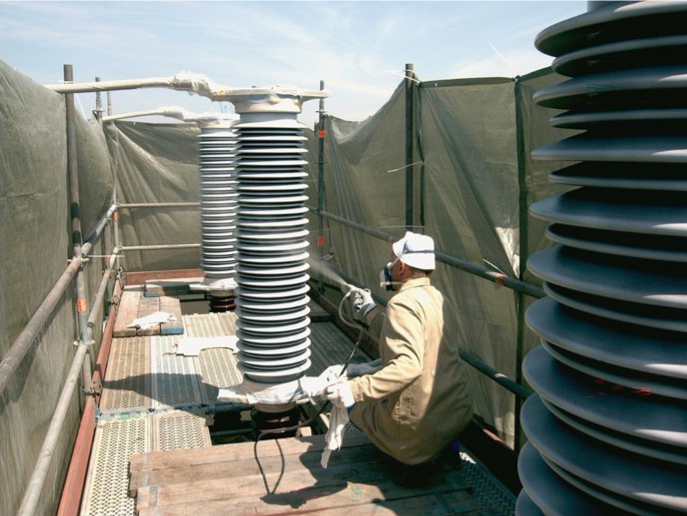
A technician applies a silicone coating to high-voltage insulators. The coating creates a hydrophobic surface that can help reduce conductive tracking and flashover risk in wet or contaminated environments. (Source: WACKER)
Application quality has a direct relationship with coating performance. The substrate must be clean and dry, the material must remain homogeneous during use, and the applicator must control thickness and cure conditions. Adhesion and coverage require verification after application. These requirements stay within the materials and process domain because contamination at the interface, poor wetting, uneven film build or incomplete cure can prevent the coating from reaching its intended properties.
For an asset owner, the practical value lies in adding a durable hydrophobic surface without replacing a structurally serviceable insulator. The decision to coat, clean, retain or replace equipment belongs to the utility and its engineering partners. The material contribution remains clear: a well-formulated and correctly applied silicone coating can improve surface behavior in polluted environments, reduce cleaning demands and extend maintenance intervals when the application fits the asset condition.
Bringing materials science into lifecycle decisions
Asset management professionals gain useful insight by asking how a component’s material system supports the intended environment and service life. A robust specification process can examine the elastomer class, cure system, processing method, electrical properties, mechanical properties, weathering data and resistance to tracking and erosion. For hydrophobic materials, the evaluation should consider recovery after environmental or electrical stress alongside the initial surface measurement. IEC TS 62073 describes contact-angle, surface-tension and spray methods for determining the hydrophobicity of insulator surfaces, with each result representing surface hydrophobicity at the time of measurement.
The questions should stay within each participant’s expertise. Utilities define system requirements, service environments and operational priorities. Equipment manufacturers design and qualify the component. Material suppliers formulate elastomers, establish processing guidance and explain how chemistry influences performance. Productive dialogue among those groups can reveal where a generic material callout leaves important variables unresolved.
This approach also helps teams distinguish material limitations from component or process limitations. A field issue may arise from an unsuitable compound, inconsistent cure, poor adhesion, contamination during assembly, damage to the finished component or a design that exposes the material to stresses outside its qualified range. Careful failure analysis should preserve those distinctions because the corrective action depends on the mechanism.
Worker safety and productivity enter the discussion through documented material characteristics. Lightweight, flexible components can support handling and installation. Hydrophobic surfaces and durable outdoor materials can reduce maintenance associated with contamination and weathering. Those benefits remain dependent on the finished equipment and the utility’s work practices, yet they demonstrate how a chemical decision made upstream can influence field conditions years later.
Chemistry as a long-term asset variable
Silicone materials support T&D infrastructure because chemists can tailor them for distinct electrical, mechanical, environmental and manufacturing requirements. Hydrophobicity, weather resistance, dielectric behavior and permanent elasticity begin with the polymer, then develop through fillers, additives, crosslinking and process control. The same chemistry can take the form of molded insulator housings, cable-accessory components or field-applied coatings because formulation and processing adapt it to the application.
For asset management, the central lesson concerns traceability. Long-term component behavior should connect back to a defined material system, a controlled manufacturing route and qualification data that reflect the intended environment. When utilities, equipment manufacturers and material suppliers maintain those connections, material selection becomes a disciplined lifecycle decision that carries through procurement and qualification. That perspective keeps the article’s focus where a chemical manufacturer can contribute with authority: explaining how molecular design and process execution shape the durability of the components that support the grid.

Dr. Nicolas Imlinger is senior director of Energy & Industrial Silicones for North and Central America at Wacker Chemical Corporation, where he leads a regional business focused on silicone technologies for electrification, infrastructure transformation and industrial applications. During more than 20 years with Wacker, he has held leadership roles in Germany and the United States spanning strategic growth, innovation, market development and business operations. Dr. Imlinger earned his doctorate from the Faculty of Chemistry and Mineralogy at Leipzig University.