For decades, light water reactors have used control rods to regulate the fission reaction that powers a nuclear plant. The rods move vertically in and out of the core and are made of materials that absorb neutrons. When operators insert control rods, the reaction decreases. When the control rods are withdrawn, the reaction increases again.
These systems also serve as a critical safety mechanism a means to rapidly shut down the reactor during an abnormal event.
While control rod systems have proven reliable for decades, the engineers who designed the U.S. Department of Energy's (DOE) Microreactor Applications Research Validation and Evaluation reactor (MARVEL) needed something smaller. MARVEL was designed to demonstrate advanced microreactor applications such as chemical production, electricity for remote locations and heat for industry.
Microreactors are a type of advanced nuclear reactor designed to be built in a factory and delivered to a site. Some are small enough to fit in cargo containers. MARVEL, an 85-kilowatt, sodium-potassium-cooled microreactor being assembled at the Idaho National Laboratory (INL), is compact about 15 feet tall and 4 feet wide, roughly the size of two telephone booths stacked on top of one another.
INL researcher Anthony Crawford and INL MARVEL Microreactor Lead Abdalla Abou Jaoude stand next to the MARVEL reactivity control system during an unveiling ceremony.
Borrowing a page from test reactors such as the Advanced Test Reactor, MARVEL uses two mechanical reactivity control mechanisms: a single control rod and four control drums rotating cylinders to help keep it small. Reactor developers are using control drums in other advanced nuclear reactor designs as well.
INL researchers are assembling and testing this reactivity control system (RCS) in Idaho Falls before it is shipped to the Transient Reactor Test (TREAT) facility at INL's Materials and Fuels Complex. The RCS assembly marks a major milestone for the MARVEL project.
"Light water reactors typically use control rods and have a lot more volume and area," said Anthony Crawford, a researcher in INL's mechatronics group. "Microreactors particularly MARVEL need more compact solutions, so we use control drums."
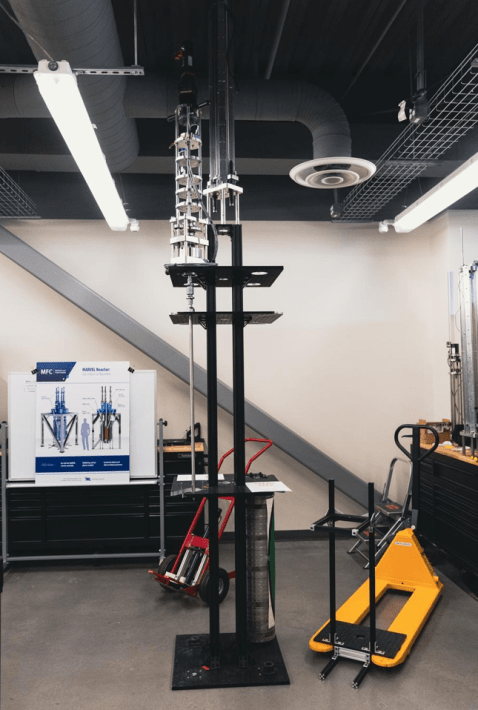
The MARVEL reactivity control system.
Operational control and layered safety
MARVEL's four rotating control drums are located around the outside of the core and have both reflective and absorber material. Depending on how far each drum is rotated, neutrons are either reflected into the core or absorbed, which increases or reduces reactor power.
"The control drum and control rod have the same basic functions one translates, one rotates," Crawford said. "But control drums are more challenging because of their inertia, bearings, penetrations and rotational dynamics. That's why industry doesn't always use them."
MARVEL also uses a central insurance absorber essentially a control rod that, when inserted, absorbs neutrons to control reactivity. The central insurance absorber is currently intended to be used only during shutdown and is, in essence, a redundant emergency feature. Together, the control drums and the central insurance absorber provide operational control and layered safety.
"In MARVEL, the control drums are the heart of how we control the reactor during operation," Crawford said. "The central insurance absorber provides defense-in-depth."
From concept to hardware
When the MARVEL project began in 2020, the reactivity control system existed largely on paper.
"We had a general idea of what we wanted to do," Crawford said. "Then we went through the full engineering process design, design reviews, analysis and moved into prototyping and testing."
INL's capabilities played a key role. The lab can design, build, test and iterate hardware under one roof. The ability to prototype and continually test is a huge advantage, especially for something as complex as a reactivity control system.
About three years ago, the design passed its 90% design review, with input from DOE, the Nuclear Regulatory Commission and other subject matter experts. "We were on the right track," Crawford said.
But real-world fabrication introduced new challenges. The system requires about 25 different functions to rotate and "scram" the drums. During a scram (nuclear operator shorthand for a full shutdown), a clutch is released and springs turn the drums quickly into the shutdown position while a damper smooths the motion to reduce impact.
"Through fabrication, we encountered things you don't necessarily see in CAD (computer-aided design) models," Crawford said. "We had to address those real-world challenges in real time with few immediately available references. Now we're assembling it. The mechatronics team developed detailed assembly plans to make sure functionality is maintained, and we test the critical characteristics of every component along the way."
Built to nuclear quality standards
The reactivity control system is being built to NQA-1 standards, the nuclear industry's quality assurance benchmark.
"This is an NQA-1 apparatus, so we have much more rigor in testing and documentation," Crawford said. "We have to prove that materials, fabricated components and employed commercial products meet NQA-1 standards, and that requires a lot of quality control."
Many of the components used in MARVEL's reactivity control system are not available off the shelf. Most of the RCS was fabricated to exacting standards at a special machine shop at the Materials and Fuels Complex. Sometimes, the engineers adapted commercial components and subjected them to extensive testing.
"That means testing at receipt, during assembly, on a test stand, during pre-operation, during operation and throughout the life cycle," Crawford said.
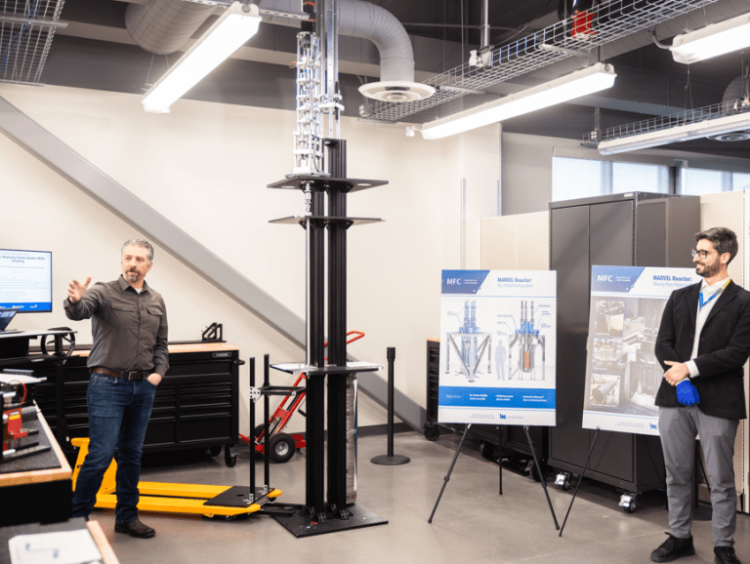
INL researcher Anthony Crawford and INL MARVEL Microreactor Lead Abdalla Abou Jaoude stand next to the MARVEL reactivity control system during an unveiling ceremony.
Precision versus speed
One of the defining challenges of MARVEL's reactivity control system is balancing two conflicting requirements.
During normal operation, the system must move with extreme precision to finely adjust reactor power. During a scram, it must move very quickly and reliably, and precision isn't as important. The hardware must also accommodate high temperature, high flux, vibration, swelling and deflection while executing both functions.
"At one point, we thought we had the perfect design," Crawford said. "Then we tested it, and it wouldn't scram because friction was higher than we expected."
The solution required significant changes: larger gearheads and clutches, redesigned springs and different damping characteristics.
The team also had to accommodate a real-world condition known as backlash. This is when two mechanical components reverse direction and there's a pause before they reengage.
"It's like a steering wheel with a lot of slop you turn it, and nothing happens at first," Crawford said. "During that pause, you don't know exactly where your end component is. In a reactor, even one or two degrees matters."
Testing the reactivity control system before the reactor is assembled has helped the researchers better understand the system and develop strategies in the design, analysis and testing processes.
A tool for the future
As of February, experts had assembled all five actuators four for operation and one spare. The control drum skeletons are assembled, with reflector and absorber material installation pending. They have built the central shutdown absorber and its spare. These systems have been installed onto a test stand that supports each control drum and the central insurance absorber system in their ultimate deployment configurations.
With this accurate configuration, the system is undergoing initial integrated qualification testing to verify speed control, precision and scram performance.
As MARVEL moves toward assembly and operation, the reactivity control system will take on a new role.
"The RCS now becomes a tool to assess the health of reactor assembly," Crawford said. "We'll test it on the primary cooling system, then again during dry criticality, then again with coolant."
The system also becomes a training tool. It will help operators better understand nuances like backlash, so they'll know exactly what's happening and how to respond.
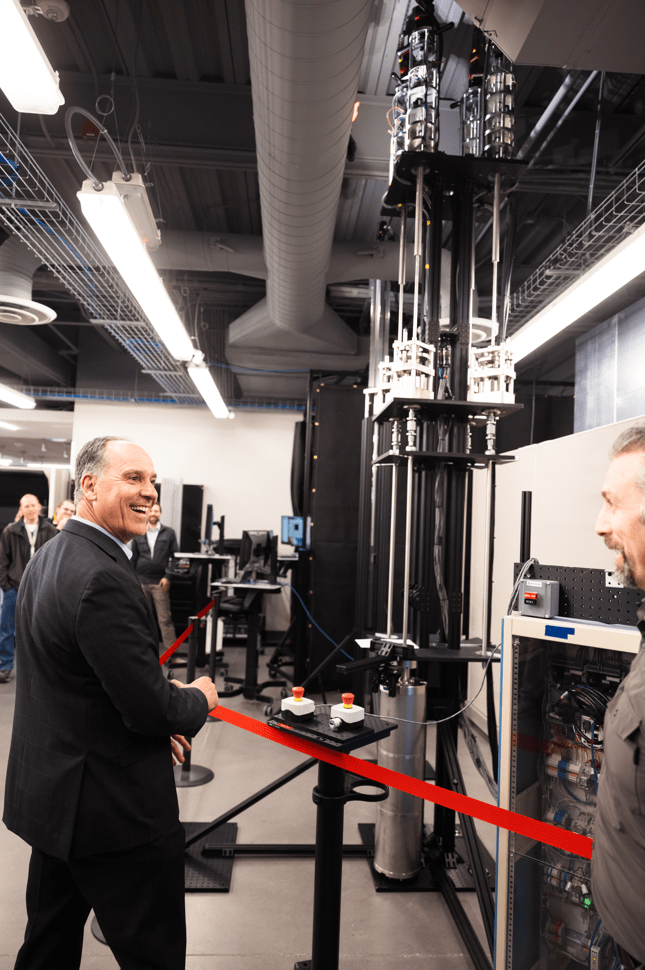
INL Laboratory Director John Wagner and INL researcher Anthony Crawford stand together at the unveiling of MARVEL's reactivity control system, a milestone more than five years in the making.
Tunable by design
Reactors do not remain static over their lifetimes. Fuel burns up. Materials swell. Friction changes.
MARVEL's reactivity control system is designed to adapt.
"We use adjustable hard stops to limit maximum reactivity early in life, then move them out as (fuel) burnup occurs to recover capability," Crawford said. "We can also adjust spring preload and swap dampers to fine-tune scram behavior."
"Without tunability, redesigns to accommodate reactor changes could take months or years, or capability could be reduced or lost," Crawford said. "With tunability, we can adapt quickly a capability that is applicable not just for MARVEL, but for other reactor designs too."
Once MARVEL is operational, engineers will be able to adapt the RCS to reflect the knowledge gained during the reactor's life cycle.
"During startup, we operate more conservatively while we learn the reactor's behavior," Crawford said. "Once we're confident, we give the system more latitude to operate efficiently and achieve its mission as a test reactor. The RCS parameters evolve with the reactor."
About Idaho National Laboratory
Battelle Energy Alliance manages INL for the U.S. Department of Energy's Office of Nuclear Energy. INL is the nation's center for nuclear energy research and development, and also performs research in each of DOE's strategic goal areas: energy, national security, science and the environment. For more information, visit www.inl.gov.