Utilities organizations are under pressure from aging assets, more frequent extreme weather, rapid growth in distributed energy resources, evolving regulation and intensifying expectations for grid reliability from customers and communities. At the same time, artificial intelligence and advanced communications networks have matured from pilot projects into capabilities that can sit at the core of grid operations. The essential shift is to treat AI and connectivity as interdependent layers of the same modernization strategy, not separate technology trends, so utilities can turn their networks into intelligence and make better decisions about risk, investment, reliability and safety.
The overlap between AI, connectivity and utilities modernization is becoming a practical roadmap for how transmission and distribution organizations will manage risk, optimize investments and keep the lights on in a more complex world. The conversation is shifting from isolated "smart grid" projects toward broader and more integrated work in data management, digital transformation, resiliency and asset management, supported by modern communications and AI insights. To that end, the communications network, historically treated as an IT component, is increasingly being touted by the industry as the power grid’s digital nervous system and as the “third grid.”
The grid as a data fabric, not just infrastructure
Utilities have spent decades instrumenting the grid with automation, advanced metering, distribution management and other digital systems. Each investment has created new data streams about the state of the system, but in many organizations these streams remain siloed, delayed, or incomplete. AI systems are only as good as the data fabric they sit on.
To support meaningful machine learning and analytics, utilities need timely, high-integrity data that spans transmission, distribution and customer interfaces. This is where connectivity becomes a strategic asset. Modern utilities networks span fiber backbones, microwave links, radio systems, private LTE or 5G and field area networks. When designed deliberately, this diverse connectivity can form a unified data fabric in which grid measurements, asset health indicators, environmental signals and customer behavior can be observed and acted on in near real time.
When connectivity is fragmented or opaque, AI initiatives stall under the weight of missing data, unpredictable latency and security concerns. Viewing the grid as a data fabric highlights a core dependency: AI is unlikely to be effective in operations and planning without trustworthy communications networks built with intelligence in mind.
© Ericsson
Three pillars of the digital grid
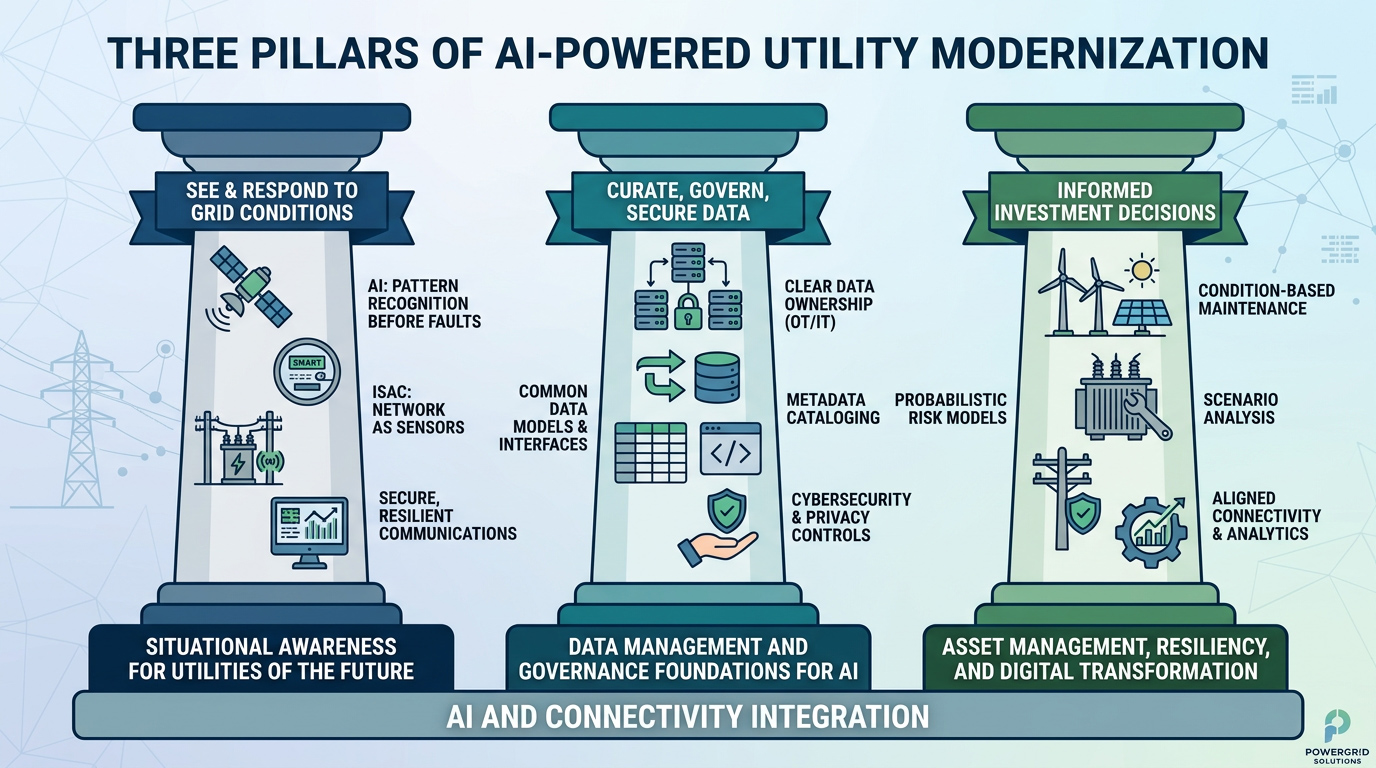
While every utility’s context is different, three pillars recur across modernization efforts that integrate AI and connectivity: situational awareness, data management and asset-centric digital transformation.
1. Situational awareness for utilities of the future
Utilities of the future will be defined by their ability to see and respond to conditions across the grid, not simply react to alarms when something breaks. AI systems can turn telemetry into situational awareness by identifying patterns that precede faults, highlighting emerging congestion and flagging abnormal behavior in distributed resources.
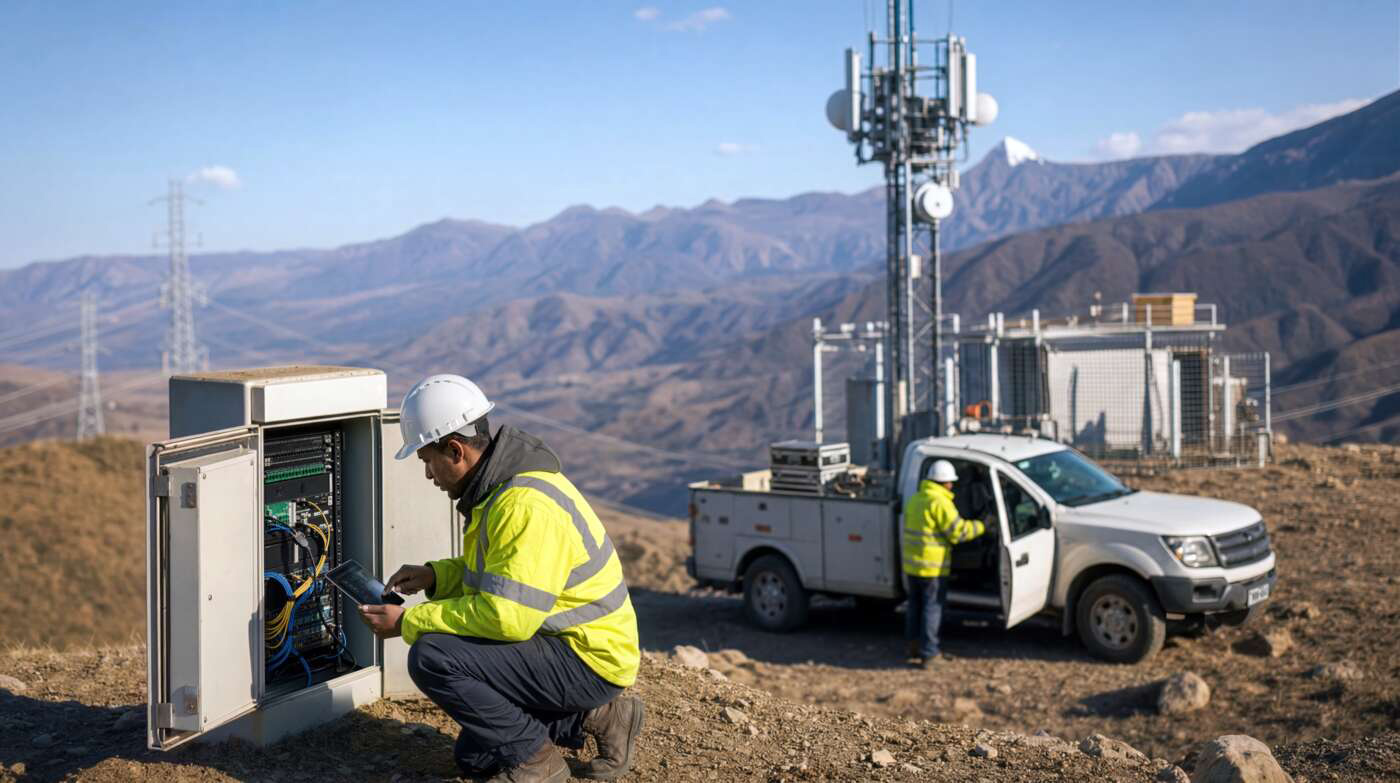
Connectivity is the precondition for this kind of intelligence. High-quality data from substations, feeders, sensors and field devices must flow across secure, resilient communication networks with predictable latency. Beyond command-and-control traffic, utilities can architect communications to support richer telemetry and allow AI to examine more dimensions of grid behavior.
Integrated sensing and communication (ISAC) conceptually treat communications networks as software-defined sensors. Although utilities may not have access to the mid-band spectrum required to deploy ISAC at scale, the principle remains the same: existing network infrastructure could serve as an always-on “eyes and ears” layer for the grid, without fully replacing field devices. Using radio signals and network intelligence, a future ISAC deployment could infer movement near a substation fence, changes in vegetation, or anomalies in line conditions. By embedding sensing into the connectivity layer, utilities could enhance situational awareness without completely overhauling field instrumentation.
In a scenario where suitable spectrum and ISAC capabilities become available, a utility could combine feeder telemetry, weather forecasts and ISAC-derived vegetation indicators to identify a specific line span where tree risk is increasing ahead of storm season. Operations teams could then prioritize targeted trimming and automation upgrades on that span instead of relying on blanket vegetation work, reducing outage minutes and wildfire risk while making better use of constrained capital budgets. This kind of focused, data-informed intervention shows how AI and connectivity could work together to turn raw measurements into concrete resiliency decisions once the underlying spectrum and ISAC infrastructure are in place.
2. Data management and governance as foundations for AI
AI models operate on specific tables, time series and feature sets that must be curated, governed and secured. A pragmatic data strategy for utilities AI includes:
- Establishing clear data ownership and stewardship across operational technology (OT) and information technology (IT).
- Building common data models and interfaces for domains such as outages, asset health, protection settings and customer programs. • Implementing metadata and cataloging so teams can discover what data exists, understand its limitations and avoid mystery data.
- Applying privacy and cybersecurity controls from the outset, treating AI pipelines as part of critical infrastructure.
Well-architected communications networks support this strategy by enabling data to be processed where it is most effective, whether in central data centers, cloud environments, or edge sites and by sustaining secure, frequent updates. Moving from batch reporting to near-real-time data streams unlocks applications such as continuous anomaly detection, dynamic risk scoring and forecasting that support operations, planning and customer programs.
3. Asset management, resiliency and digital transformation
Asset management and resiliency are where AI and connectivity most visibly intersect with investment decisions. Utilities face difficult choices about which transformers to replace, which lines to harden, where to invest in automation and how to prioritize vegetation management and storm hardening.
Combining telemetry with AI will support condition-based maintenance that uses vibration, temperature, loading and historical fault data to estimate asset health; probabilistic risk models that account for weather, wildfire, flood exposure and asset criticality; and scenario analysis of different investment portfolios and their effects on reliability and customer experience.
Connectivity is the enabler. Sensors and monitoring systems must communicate reliably, even under duress, if AI models are to reflect reality. When communications architectures are designed with path diversity, segmentation and appropriate quality of service, utilities can continue feeding AI systems with usable data even when parts of the physical network are stressed. Digital transformation in this context is about aligning connectivity, data and analytics so that asset decisions are informed by continuous insight instead of static reports.
© Ericsson
Designing AI-ready connectivity
AI-ready connectivity begins with recognizing that, as AI workloads grow, uplink traffic from sensors, cameras and edge devices will increase sharply — and that utility communications networks must evolve from a loose collection of links into a deliberately engineered platform. Those design principles include:
- Deterministic latency and bandwidth for critical AI workloads, so protection relays, control commands and safety signals receive strict performance while less critical telemetry can tolerate more variation.
- Uplink-optimized capacity and traffic management, so growing volumes of telemetry field data can be transported reliably for AI models to consume.
- Edge-aware architectures, placing compute resources at central offices, substations, or aggregation points to balance central analytics with processing close to the asset.
- Interoperability and standards that favor open interfaces across fiber, radio, IP networks and operational protocols, reducing vendor lock-in and easing integration of new AI tools and sensors.
- Security by design, incorporating encryption, strong authentication, network segmentation and continuous monitoring, so utilities can expose the data AI needs while protecting critical operations.
Viewed together, these principles help utilities frame connectivity decisions as part of a broader AI and modernization strategy. Communications networks have become the platform on which intelligent grid applications are built.
© Ericsson
A roadmap to intelligent infrastructure
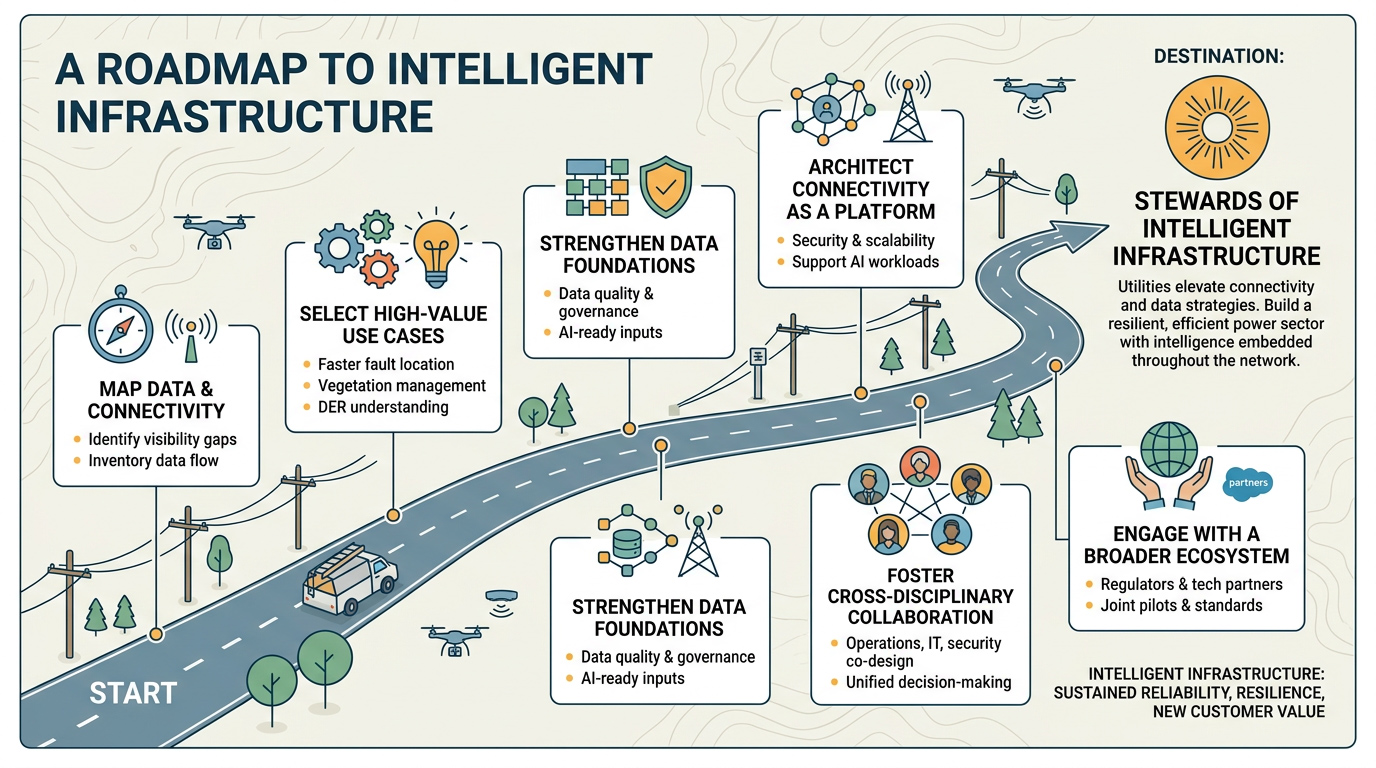
Utilities do not need to solve every AI and connectivity challenge at once. A practical roadmap can focus on incremental steps that build toward a more intelligent, resilient grid and position utilities as stewards of intelligent infrastructure.
- Map data and connectivity
Inventory where data originates, how it moves and where it is stored. Identify gaps in visibility and communications coverage, especially along high-voltage corridors, at substations and in regions with high Distributed Energy Resource (DER) penetration.
- Select high-value use cases
Start with problems such as faster fault location, improved vegetation risk management, more accurate load forecasting, better understanding of DER behavior and enhanced safety at critical sites. Align AI and connectivity initiatives with these needs, focusing on a small number of use cases where AI-ready connectivity can show measurable benefit within a reasonable period.
- Strengthen data foundations
Invest in data quality, modeling and governance in parallel with connectivity upgrades. Treat data platforms as part of grid modernization, not just back-office IT, so AI initiatives have reliable inputs.
- Architect connectivity as a platform
Design communications networks with clear performance, security and scalability objectives that support current and anticipated AI workloads. Consider how ISAC and other sensing approaches can augment existing strategies and feed situational awareness systems over time.
- Foster cross-disciplinary collaboration
Bring together operations, planning, IT, cybersecurity and field teams to design AI-enabled workflows and agree on how AI insights will be used in real decisions, from dispatch to capital planning and regulatory engagement.
- Engage with a broader ecosystem
Collaborate with regulators, technology partners, research institutions and other critical infrastructure operators around standards, data sharing and joint pilots, especially in areas like ISAC and edge AI for grid resiliency.
Utilities as stewards of intelligent infrastructure
The convergence of AI, connectivity and utilities modernization represents a shift in how the power sector thinks about infrastructure. Transmission and distribution networks are no longer just physical assets; they are becoming systems capable of sensing, learning and adapting.
Realizing that potential requires utilities to elevate communications networks and data strategies to the same level of importance as lines, transformers and substations. When connectivity is robust and well designed, AI can help turn raw data into decisions that improve reliability, optimize investments and enhance safety. When connectivity is fragmented or opaque, even sophisticated algorithms struggle.
By treating the grid as a data fabric, investing in AI-ready connectivity and approaching modernization through vendor-neutral architectural principles, utilities can build foundations for a future where intelligence is embedded throughout the network. In that future, AI is not a bolt-on tool and connectivity is not a background service; together, they become the nervous system of a more resilient, efficient and responsive power sector. Utilities that elevate connectivity and data strategies to the same level as lines, transformers and substations and co-design AI-ready networks with regulators, technology partners and other critical infrastructure operators will be best positioned to turn intelligent infrastructure into sustained reliability, resilience and new customer value.

Per Wahlén is head of CU US Hyperscalers and regional accounts at Ericsson, working at the intersection of advanced communications networks, AI-driven services and mission-critical customers across utilities, public safety and critical infrastructure. With more than two decades in global leadership roles, he brings an operator-centric, field-driven perspective on how modern connectivity, data and intelligent networks can support grid modernization, resilience and new utilities business models.